
The Great Stone Debate: Understanding the Real Differences Between Granite, Marble, and Sandstone
Choosing the wrong natural stone can lead to unexpected cracks, stains, or fading. Learn the critical differences in geology, durability, and usage between granite, marble, and sandstone.
vaibhav bapna
8/5/20243 min read
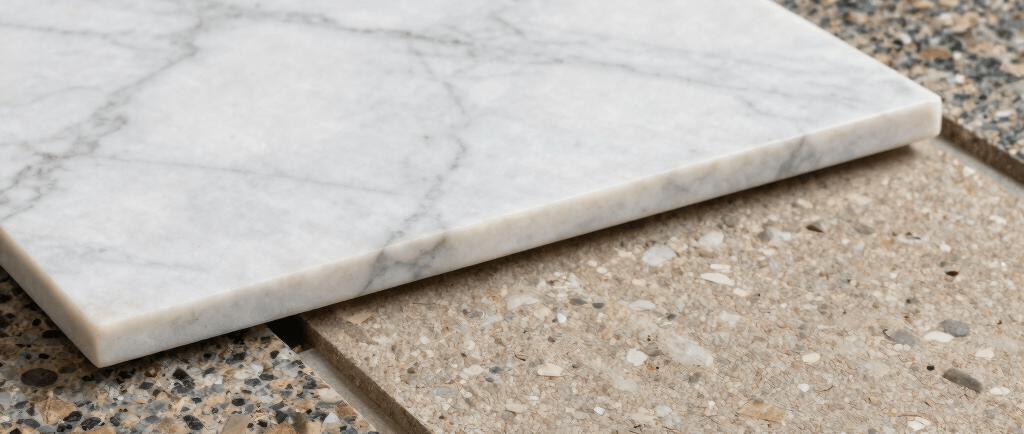
When planning a home renovation or architectural project, walking into a stone yard can be overwhelming. Slabs of granite, marble, and sandstone look beautiful, but they are radically different materials.
Choosing the right stone is not just about finding a color you like—it is about understanding how the stone was formed, how it behaves, and where it can successfully be installed. Using the wrong stone in the wrong place can result in irreversible stains, scratches, or weather damage.
Here is the ultimate professional breakdown of the differences between Granite, Marble, and Sandstone.
1. The Core Scientific Differences
The fundamental differences between these stones come down to how they were created deep within the Earth over millions of years.
[ Igneous Rock ] [ Metamorphic Rock ] [ Sedimentary Rock ] Granite Marble Sandstone (Volcanic Magma) (Altered Limestone) (Compressed Sand)
Granite: The Volcanic Powerhouse
Geological Class: Igneous rock.
How it’s Made: Granite is formed when molten volcanic magma cools and solidifies slowly deep beneath the Earth's crust. Under immense pressure, minerals like quartz and feldspar lock together to form an incredibly dense, crystalline structure.
Visual Appearance: Known for its speckled, granular pattern or dynamic, sweeping crystalline movements.
Marble: The Elegant Transformation
Geological Class: Metamorphic rock.
How it’s Made: Marble begins its life as sedimentary limestone. Over vast periods of time, intense heat and tectonic pressure recrystallize the limestone, changing its atomic structure into calcite (Přikryl, 2013).
Visual Appearance: Celebrated for its smooth, flowing, and high-contrast veins, along with a distinct characteristic translucency that reflects light beautifully (Kaur et al., 2022).
Sandstone: The Earthy Monument
Geological Class: Sedimentary rock.
How it’s Made: Sandstone is formed at the Earth's surface or ocean floors. It is composed of mineral particles (mostly quartz and feldspar) that accumulated over millennia and were bound together by natural mineral cements under the pressure of overlying layers (Gurocak et al., 2012).
Visual Appearance: It features a distinct, granular, sand-like texture with visible horizontal layers or rich, warm banding reminiscent of desert landscapes.
2. Durability, Porosity, and Maintenance
How a stone forms directly determines how tough it is in daily use.
FeatureGraniteMarbleSandstoneHardness (Mohs Scale)6 to 7 (Very Hard)3 to 4 (Soft / Scratchable)6 to 7 (Hard grains, soft matrix)PorosityLow (Resists stains well)Medium (Prone to staining)High (Absorptive if unsealed)Acid ResistanceHigh (Unaffected by lemon/vinegar)Low (Acids cause dull "etch" marks)Medium (Depends on the binding minerals)Primary StrengthExtreme scratch & heat resistanceLuminous beauty, timeless luxuryHigh slip resistance, rustic texture
3. Where Should You Install Them?
Because of their physical profiles, each stone belongs in a specific environment to perform its best:
Where to Use Granite
Because it resists knife scratches, hot pans, and heavy foot traffic, granite is the king of utility.
Best Applications: Kitchen countertops, high-traffic commercial flooring, outdoor kitchen islands, and heavy-duty stairs.
Where to Use Marble
Marble requires a gentle hand. It is sensitive to household acids (like lemon juice, wine, and coffee), which can chemically dissolve the surface polish—a process called etching.
Best Applications: Master bathroom vanities, fireplace surrounds, decorative wall panels, and low-traffic formal entryways.
Where to Use Sandstone
Sandstone is highly slip-resistant because of its gritty texture, making it the premier choice for transitioning indoor spaces to the great outdoors.
Best Applications: Pool decks, outdoor patios, garden walkways, rustic accent walls, and architectural cladding (Samarakoon et al., 2023).
Summary Guide for Buyers
If you want zero maintenance and high durability: Choose Granite.
If you want high-end prestige, artistic veining, and a luxurious feel: Choose Marble.
If you want a natural, rustic, textured finish for outdoor landscaping: Choose Sandstone.
References
Gurocak, Z., Solberg, A. K., & Alemdag, S. (2012). Evaluation of color change in natural sandstones used as building stones due to environmental factors. Environmental Earth Sciences, 66(4), 1145–1153. https://doi.org/10.1007/s12665-011-1322-z
Kaur, J., Kumar, R., & Kaur, M. (2022). Psycho-spatial impact of colors and textures of natural stones in residential interior environments. Journal of Interior Design & Architecture Studies, 7(2), 45–58.
Přikryl, R. (2013). Assessment of stone color and its variations for architectural applications. Construction and Building Materials, 40, 233–242. https://doi.org/10.1016/j.conbuildmat.2012.09.098
Samarakoon, K. G. A. U., Chaminda, S. P., Jayawardena, C. L., Dassanayake, A. B. N., Kondage, Y. S., & Kannangara, K. A. T. T. (2023). A Review of Dimension Stone Extraction Methods. Mining, 3(3), 516–531. https://doi.org/10.3390/mining3030029
Bapna Marbles (INDIA)
Reach out for custom marble and granite work
Phone
© 2026 Bapna marble (India). All rights reserved.
Address
Bapna marble opposite kota stone, Kelwa Road, pasoond rajsamand - 313324, India.
Contact
Connect with us